Post Professional Graduate Degrees
The post-professional Master of Architecture degree program provides an environment for serious inquiry into the nature of architecture. Post-professional study is available to students wishing to develop a specialization in architectural theory and practice. Applicants must have an accredited degree in architecture or its equivalent. Distinct areas of study offer students the opportunity to investigate specific aspects of architecture and to elaborate their understanding for future teaching, research, publications and professional practice.
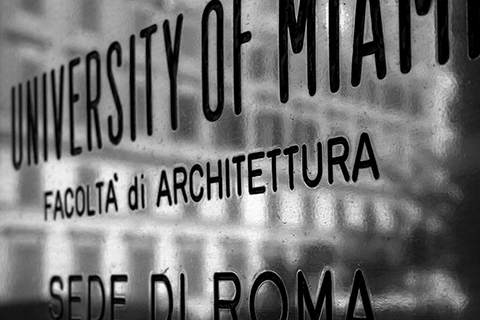
Master of Urban Design: A 3-semester (Summer/Fall/Spring) Post-Professional Master taught in Miami and Rome focusing on New Urbanism and Emerging Urbanisms
Urban design is remodeling, adding, subtracting, reworking, relating, and reforming three-dimensional spaces for human activities, including all pedestrian and vehicular systems. Urban design deals with the old and the new, the expanded and the contracted, the humdrum and the extraordinary. It brings people together. It separates people. It commemorates its history. It never lies, but portrays life three-dimensionally as it really is. At its best, it creates related and usable exterior spaces, provides means of “getting there” and a “there” once you are “there.” It is the mother art of civilization, for it allows and, indeed, demand ideas, thinking, reactions to opportunities of the moment, executed in the spirit of its time, but demands respect for its earlier efforts. The new depends on the old and is responsible for the future. If the old is ignored, misunderstood, the future will mock the seemingly new and reveal for all the plainly see the false thinking expressed. All the other arts are handmaidens to urban design.
Paul Rudolph, L’arca, nº 62, July/August 1992. From Paul Rudolph, Writings on Architecture, Yale University Press, 2008.
The Master of Urban Design at the University of Miami School of Architecture brings together students and faculty in the exploration and definition of guiding principles of urban design for building better communities. Dean Elizabeth Plater-Zyberk and Adjunct Professor Andres Duany are renowned for their dedication to the evolution of the principles of New Urbanism to direct the design and development of existing cities and neighborhoods as well as urban alternatives to suburban sprawl. Faculty and lecturers from around the world share ideas with students in the investigation of the environmental context of town design through economic, social and cultural analysis.
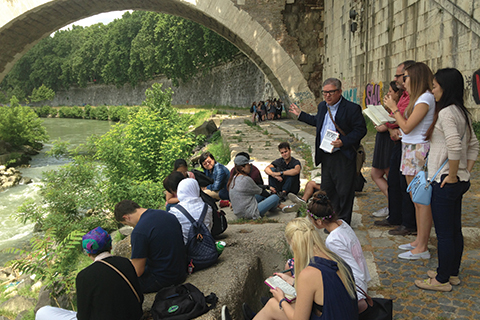
The year-long three-semester curriculum starts with an introductory summer session at the School of Architecture Center in Rome; it deals with the study and analysis of major principles and methods of urban design, using Rome and its area as primary source. The fall semester deals with issues of re-urbanization of neighborhoods, urban and suburban centers, using infrastructure, housing and mixed-use structures as vectors of densification. The spring semester is the “capstone” semester which allows the students and faculty to explore larger scale issues such as regional development, foundations of new towns and cities, impact of global warming, emerging urbanisms, etc.
The curriculum offers special opportunities to work directly with municipalities or private sector groups and prepares students to be effective designers and advocates for both private sector and public sector development enterprises. The highly integrated curriculum and close faculty support ensure an intensive and rewarding experience which draws from vanguard work in the academy and the profession. The program establishes an environment characterized by an active, dynamic exchange of ideas, and a forum for testing and advancing design proposals that enlighten the effort to build a sense of place and community in every architectural endeavor.
Master of Architecture in Research (Post-Professional)
This program allows students to specialize in a specific area of study within the context of the discipline. Each student must complete 36 credits, normally over three semesters. A specific program of study, reflecting the proposed professional objectives, is established for each student. A six-credit thesis is required. An advisory committee of the faculty of the school supervises the progress of the students.


Professor Teofilo Victoria with students in the Skyscraper Studio. An urban plan for teaching suburb and town design.